A scar is not simply the final result of a wound or surgical procedure, but the outcome
of a complex, dynamic and prolonged biological repair process.
Understanding the relationship between scars and sun exposure is essential to prevent
undesirable aesthetic outcomes, some of which may be difficult—or even impossible—to reverse.
A scar is not normal skin
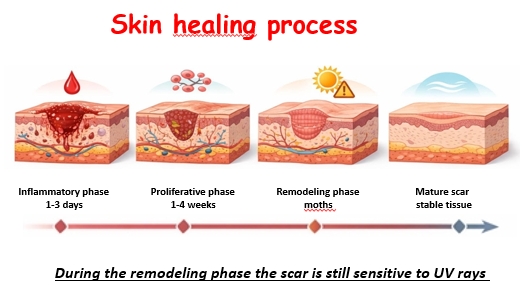
During wound healing, the skin passes through three successive phases:
Inflammatory phase
Proliferative phase
Remodelling phase
This process may continue for many months and, in most cases, for approximately one year.
During this period, scar tissue is characterized by:
immature or disorganized collagen architecture;
altered vascularity;
an irregular distribution of melanocytes.
As a result, the response of scar tissue to external stimuli—particularly ultraviolet
radiation—differs markedly from that of normal skin.
During the remodelling phase, the scar is still sensitive to UV rays.
Why does the sun interfere with scar healing?
Exposure to solar ultraviolet radiation during the remodelling phase may result in:
Persistent post-inflammatory hyperpigmentation
Hypertrophic scar formation
Permanent darkening of the scar
A poorer overall cosmetic outcome
A common misconception is that once a wound has closed, the scar can safely be exposed
to sunlight. This is not the case.
When should direct sun exposure be avoided?
During the first 6–8 weeks after surgery or trauma, scars should
never be exposed directly to sunlight.
During this early phase, protection should be physical, using clothing, dressings
or adhesive coverings.
What to do
Always keep the scar covered during the first weeks.
Whenever possible, choose protective clothing such as T-shirts, hats or wetsuits
rather than relying solely on sunscreen.
Consider both the anatomical site and the individual's skin phototype.
What to avoid
“Expose it gradually so it gets used to the sun.”
Using sunscreen as the only form of protection.
Sun exposure during the middle of the day.
The risk of scar hyperpigmentation
Post-inflammatory hyperpigmentation is one of the most common complications.
It occurs more frequently in medium and dark phototypes.
It is more common on the face, chest and shoulders.
It is promoted by intense or repeated sun exposure.
Once established, it may require specific treatment and may take a long time to
resolve—or, in some cases, become permanent.
Photoprotection of scars
When sun exposure cannot be avoided—as may occur in people who practice water sports
professionally—the following precautions are recommended:
use SPF 50+ broad-spectrum sunscreens, preferably tinted formulations;
choose high-substantivity formulations, such as creams, pastes or sun sticks;
reapply sunscreen frequently during outdoor activities;
whenever possible, combine sunscreen with protective clothing.
Key Message
Whenever possible, sun exposure should be planned only after medical evaluation.
Protecting a scar from sunlight is not excessive caution—it is simply respecting
the biological time required for skin healing.
Exposing a healing scar to the sun means interfering with the natural tissue repair process.
The final outcome depends not only on the quality of the surgical procedure, but also
on appropriate postoperative care.
During the early stages of scar healing, sunscreen should never be considered a
substitute for physical protection.